Hydra: Creativity and Destruction
What inspires authors, at specific times in their lives, to write about their past?
- by Tamar Hodes, author of "The Water and The Wine", published 2018.
In my case, I’d intended for many years to capture my time on Hydra; but it was only after a sequence of events, like a groundswell beneath me, that I was eventually led to doing so.
My father passed away in 2013, leaving me a journal concerning his return to Hydra in 1983, eighteen years after we’d lived there. His incredible detail – how to cook an octopus, when camellias bloomed, the wrinkly skin covering Greek yoghurt – transported me back.
The following year, my mother died and left me a first edition of Flowers for Hitler signed by Leonard Cohen for her friend Charles, which he’d passed to her. Then, in 2016, Marianne Ihlen died in July, followed by Cohen himself in November. He had sent her a beautiful letter: I am so close behind you that if you stretch out your hand, I think you can reach mine.

Lastly, I discovered a 2005 interview with Kari Hesthamar in which Cohen declared that it would take a novel to capture the period when he and Marianne had lived on Hydra.
At that stage, no such novel had been written.
I sensed that it was time for me to write The Water and the Wine, which was published in 2018. The title is inspired by Cohen’s song Treaty; it seemed appropriate. In a literal sense, the water in our well was a lifeline while the wine flowed freely in the tavernas. But more deeply, our lives there were in some senses, primitive but, in other ways, as heavenly and rich as red wine.
In April 1965 my parents, older brother and I arrived on Hydra. The almond blossoms were fresh sprigs against an azure sky; the cobbles bubbled in the sun.
We collected the key from Douskos’ Taverna and were transported by donkeys up the hill to our rented, whitewashed house. There was a well in the garden and a large balcony at the back, overlooking the many red rooved homes, similar to ours.
I’ll never know how my parents - originally from South Africa but living at that time in Israel – came to hear about the artistic community on Hydra. Maybe they’d seen James Burke’s 1960 photo spread in Life magazine, picturing Leonard Cohen and Marianne, Charmian Clift and George Johnstone, the sculptor Norman Peterson and others. Whatever the reason, being bold and bohemian, they decided to take us there. My father had a commission to write a book about Martin Buber; my mother was a painter.
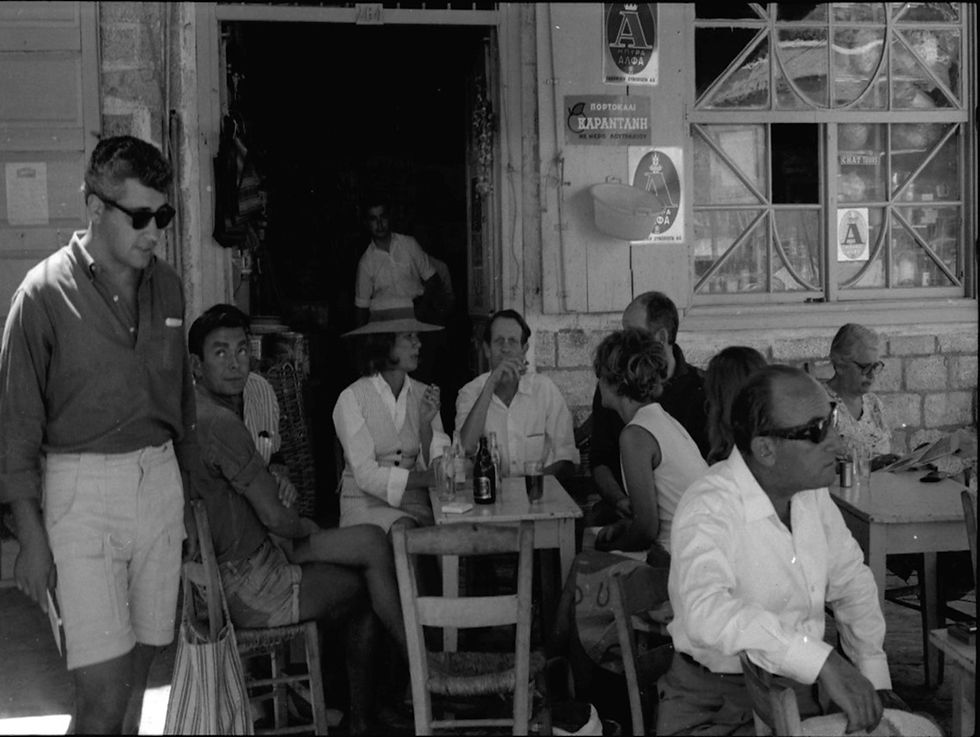
My parents settled quickly into Hydra life. They loved the island, and the time it gave them to focus on their work. (All the artists had maids; ours was called Evgenia.) Most of all, they relished the nightly gatherings at Douskos’ Taverna, where they sat beneath the pine tree, the wisteria threaded through its branches, releasing its sweet scent into the still warm air. The artists and writers, drinking retsina and eating olives, discussed their projects as well as topics ranging from Buddhism to John Cage, I Ching and Jung. How stimulating that must have been.
But what of the children? My brother attended the one-roomed school while I was cared for by Evgenia, but essentially, we were feral, running barefoot across the island, searching for stray cats in the harbour and feeding the wild goats. Some would call it freedom; others neglect.

Looking at the biographies of the island children in adulthood – Axel, the three Johnston children, for example – their lives were tragic. I once asked my father where my brother and Iwere at night when they were out. He said that we were asleep and that they checked on us every few hours. I am sure that nothing awful happened to us but, to this day, I can’t be alone at night.
Cohen claimed that the artists were doomed. They were escaping humdrum lives, searching for an alternative, aesthetic life, but it wasn’t all idyllic. Most (apart from Cohen) were renting their homes and worried about money, eagerly awaiting payments from their publishers. And there were complicated relationships too: infidelity, fierce arguments, alcohol, drugs, a looseness that occurs when barriers are removed.
As I was only young then during my time on Hydra and my memories were limited, research for The Water and the Wine came from books and articles about the community, stories I was told by my parents and others, and an informative trip to the Greek Embassy in London.
The facts about now famous people were adhered to; but my family - here named as Jack and Frieda Silver, my brother Gideon and me, Esther (my middle name), was fictionalised. In this sense I disguised and protected my loved ones but tried to capture a certain truth about that time.
Many themes are explored in the novel: is what is good for adults good for children? How much structure or stability do youngsters need? Do you escape your demons by moving to another place? On an island, eventually, you are bound to meet yourself, wrote Charmian Clift. When you leave the island, where do you go? How do you settle back into a regular, structured life when you’ve seen the alternative? Cohen believed that once you’d lived on Hydra you couldn’t live anywhere else.
He also admitted that Hydra was both creative (so many wonderful songs, novels, paintings and sculptures originated there) and destructive. It was certainly a place of paradox and contradiction. The artists were free and yet restricted. They were searching for the truth about human life but were distanced from it. They were concerned with mundanity but also aesthetics.
The water and the wine.

Anna Kwiecinska is very grateful to Tamar Hodes for sharing this story for this website.
This site aims to share the wealth of Hydra's fascinating literary history; Anna Kwiecinska, who spent two perfect years on Hydra, curates retreats for writers, readers and creative thinkers, some of them on Hydra. These two forthcoming retreats relate to Tamar's story:
HYDRA OCTOBER 2026 - Ring the Bells - a creative writing retreat for Women with author Joanne Fedler and Anna Kwiecinska, drawing on the poetry and lyrics of Leonard Cohen to open the doors onto our own creativity.
HYDRA OCTOBER 2027 - Half the Perfect World - a literary retreat with Prof. Tanya Dalziell and Dr Paul Genoni, authors of the award-winning history of mid 20th Century Hydra, Half the Perfet World. several excerpts from this book are published as blogs on this site.Tamar Hodes will be with us via a zoom meetup during this retreat.
You can contact Anna; anna@annakwiecinska.com or anna@writingbytheseainhydra.com

Comments